Thursday, September 29, 2011

Taliban Tweet Battle....yo


The following is an exchange between the Taliban spokesman (spox), Abdulqaqhar Balkhi, and the International Security Assistance Force's twitter-guy. From the Guardian:


ISAF: "Re: Taliban spox on #Kabul attack: the outcome is inevitable. Question is how much longer will            terrorist put innocent Afghans in harm's way?" 

Taliban: "@ISAFmedia i dnt knw.u hve bn pttng thm n 'harm's way' fr da pst 10 yrs. Razd whole vllgs n mrkts.n stil hv da nrve to tlk bout 'harm's way" 

ISAF: "Really, @abalkhi? UNAMA reported 80% of civilians causalities are caused by insurgent (your) activities http://goo.gl/FylwU" 

Taliban: @ISAFmedia UNAMA is an entity of whom? mine or yours?


Damn.


That was a few weeks ago. They're still fighting today:


ISAF: 11 children among dead. Noticed  didn't tweet this one.


But who ever is in charge of the ISAF twitter page is fully engaged, as seen in today's exchange with  Joshuafoust

h/t: Harith Ramli

Friday, September 23, 2011

Machine gun preacher and SS Cinema

"Is there any movie about South Sudan?" a good friend and SPLA soldier asks me in Juba Arabic.

"Non that I know. Although I heard they are making a movie about a khawaja who is apparently rescuing children from the LRA" I reply.

He stares at me blankly.....not so much because my Juba Arabic is incomprehensible but because the idea of the only movie about South Sudan is about a white guy. A white guy that he has never even heard of.

The Machine Gun Preacher movie premiered on the 21st somewhere far enough away from the location of where the story comes from, that the peripheral characters are unable to stand up and scream

"Who are these people and when the hell did any of that happen?!"

I could go on to talk about Sam Childers' methodology with explosive cynicism, but there are plenty of other blog posts that have covered this issue in the past. But I won't. I would however like to refer you to this rather interesting article written by Sister Rose Pacatte, the National Catholic Reporter's official film reviewer. For those of you who have been following the story of the Machine Gun preacher, you may notice that the quotes used in this article suggests that Sam Childers has somewhat come to realise the faults of his own actions and is dialing down the self-righteous machoism.......he still sounds batshit crazy though.

Anyways, at the moment, my biggest problem with this is that this preachy piece of shit is going to be the first movie about South Sudan. And I mean movie movie, documentaries don't count because most of the world's population can't quite be bothered to watch a documentary.

However this movie portrays South Sudanese is how the world will come to see them, a nation who needed a single white knight to come and rescue their children. Forgotten will be the struggle of the South Sudanese soldiers who fought for decades to achieve their freedom. From what I can see in the previews, this movie may even go so far as to portray the SPLA as being an impedance to the protection and rescue of the children.
For me that is probably the worst crime of this movie.
Luckily, there are those out there who want to do justice. Lekan Ayinde and Dare Folder. Two Nigerian film makers who have come to Juba to produce "Salt of The Nation"


The director says that "Salt of the Nation" is about "the Sudan of yesterday, today and tomorrow." Folder said the movie addresses the struggle South Sudan has gone through and the challenges it will face after the referendum.

I for one will be saving my popcorn for this film to be available (I think the movie might already be out, but I have not been able to find it anywhere).

Monday, September 12, 2011

Yes, a new capital.

Suck my decadence (photo credit: David Adams)

(Update 15/9/11: See comments for my fail)

Sorry for the absence but apparently I have greater access to the internet in Juba than I do in my current location.....also, I had not come across anything that enraged me enough to encourage me to write........

So the Government of South Sudan has somewhat recently announced that it is planning to move the capital to a state-neutral area called Ramciel. This is not the first time GoSS has made this announcement and there seems to be just as much criticism to the idea this time around. Some Smug faced Guardian newspaper journalists has so kindly shared his view on the matter based on his "lightning visit" of Juba. The legend that is John Ashworth has so succinctly explained in the comments section

"A lightning visit" sums up the international media's understanding of South Sudan.
It is evident in reading the article and its romanticised description of Juba as some wild west town that the writer is missing some pretty important arguments as to why GoSS has come to this decision. You can find some more elaborate explanations in the comments section written by some South Sudanese, but here is my summary:


  • As the article suggests, Juba is growing very rapidly. However, the land around it does not belong to the government. As the South Sudan Land Act 2009 indicates, land is primarily owned by the "community". The land that surrounds Juba is owned by the Bari community, who are not particularly happy with Juba expanding anymore than it already has. So they can pretty much charge whatever they want for the land, and are very much motivated to charge ridiculous prices to discourage any further expansion. Therefore moving to newer cheaper land may be just as cost effective as staying (I am merely speculating and will not be doing the calculations for this).
  • Starting from scratch will mean that the government is able to plan out the new city much better to allow for infrastructure to be developed much more efficiently. For example, the current water supply system in Juba are rather small pipes that have been barely submerged in the ground. When ever it rained, the pipe near where I lived would be exposed, punctured and would turn the road into a river. Wasting treated water as well as making it a bitch for me to get home. 
  • Actually, screw this.....the article says "For outsiders, the decision [of moving the city] seems baffling", then fine, be baffled. People on the inside are just as baffled as to how the Guardian would publish such poorly researched articles. I've heard South Sudanese primary school children come out with more intelligence on development issues than this garbage. 
Although one point I would like to make that is independent of the Guardian article is that I worry about the motivation of selecting the location for the new capital. While it is great that the government is trying to keep everyone happy*, I fear that always making concessions to all parties as opposed to making decisions based on actual merits may be a shot in the foot in the long term. Nothing can make everyone happy all the time.  

To my friends still working in Juba, the capital city moving away simply means that you can still be based in Juba with all its bars and swimming pools while having the bonus 'badass points' of saying your living in the field.


* even though the Ramciel, while straddling multiple states is in fact very much Dinka country. Credit goes to Chagai  in the comments section of the Guardian article for this one. 

Sunday, August 28, 2011

In which I say good bye.....

Sorry for the lack of posts recently but I’ve been somewhat busy travelling and have not had much access to the net. The thing is, I’ve left South Sudan. My work here is over, only peace will ensue from now on... You're welcome.

It has been a tremendously exciting experience and I am eternally grateful for having been able to be here for such a momentous period in the history of this new nation.

Anyways, something a little personal, here is a list of things of consideration that I will be taking away with me.

Things I’m going to miss:

  • My peoples
  • Riding my motorcycle through Juba while being terrified for my life as cars seemingly target to run me over
  • Playing ‘Boda-boda’ (motorcycle taxis) to the local law enforcement, as well as random strangers
  • The consistency of the sun
  • Hazy nights hanging out and exchanging stories with my SPLA buddies
  • Watching the rapid development of Juba. As each day passes, building get taller, the streets get brighter and life gets ever more decadent….. for me.
  • Not being in an always-thrilling context that never stagnates.
  • Working in a context where you can claim to be an expert of simply because there isn’t really any way of verifying the stuff you just totally made up.

Things I’m not going to miss:

  • The UN

Things Im going to struggle getting used to in the real world

  • Humvees not accounting for 10% of vehicles on the road
  • Not using the hazard lights when signalling to drive straight through a rounadabout
  • Speaking dialects of Arabic that has a proper grammar
  • Not seeing people carry livestock on to an airplane…. straight up, two ducks in a basket.
  • Picking my nose in public like it’s noteven an issue.
  • Traffic laws
  • Being around people who think Prendergast is an alright guy with good ideas.
  • Being around people who think the Machine gun preacher is going to win an oscar
  • Having to worry about crime….. unless I happen to have aload of cattle.

As for the blog, if you all will permit me, I would like to continue writing when possible. To counter the fall in the legitimacy due to my absence in South Sudan, I have ‘field correspondences’ who I know will be very vocal to any bullshit I try to post and who will also keep me updated on information that is readily availableto those outside the country. There are probably more heartfelt sentiments that I could share about leaving, but I am on my first holiday in a very very very long time andwill therefore go and have fun with that instead.

Tuesday, August 16, 2011

The impact of blogs VII: Effect of bloggers blogging about other bloggers on the blogosphere.....blog


Development Impacts has an interesting series of articles titled "Impact of Economics Blogs" that makes bloggers feel like they matter. There are currently 3 parts, with more come (I,II,III).

Currently, my favourite is the article that looks at the effect of blogging on the dissemination of papers and whether blogging about a paper lead to it being accessed/disseminated more. The study found that "Blogging about a paper causes a large increase in the number of abstract views and downloads in the same month"

They provide some lovely examples:

Here is one using Chris Blattman's blog:

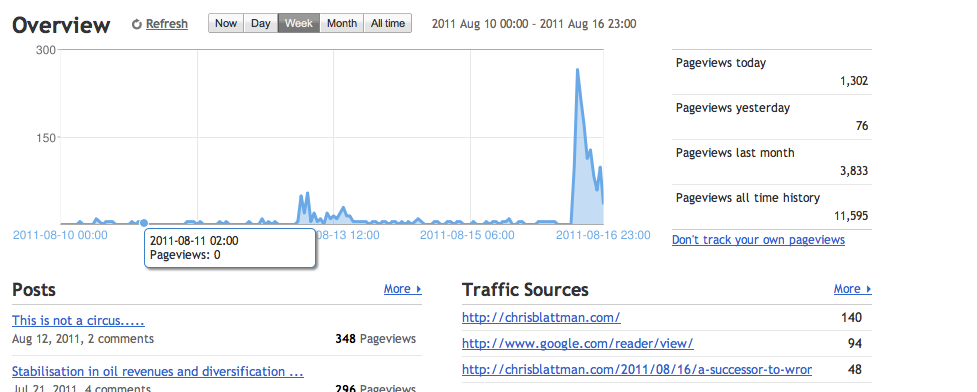
Oh wait....no, that's this blog's stats page. However, it seems that the graph is showing a similar effect. A sudden massive surge in hits from a mere few hours?! From 76 one day to 1,302 the other....What incredible force could have caused such a spike?

Na, na, na, na, na, na, na, na, Blattman!

But I am not alone in having experienced this effect. This is Roving Bandit's after Blattman posted about his blog.


With a massive sample size of a 2 I think we can safely declare this an effect.

The Blattman Blog Effect.

Now how can I use this new found fame as a chat up line?.......

Friday, August 12, 2011

This is not a circus.....


Hello,

My name is Douglas Lyon.

I work for Japanese television. ( I am however based in Paris, France).

Permit me to use this Google group for my research : I wanted to ask your
guidance... ( and by the way, if you have alreade received this yesterday,
please forgive me... I have never used Google Groups before... )

I currently have a project to visit South Sudan, at the end of this month,
to film for a Japanese television show.

I am looking for something "wild and crazy", or exotique, or funny... This
is for a comedy show, but we want people to be aware of the birth of the
worlds newest independant nation... So the idea is to go to South Sudan,
and do... Something ... "For the first time ever in South Sudan".

I was hoping to find something particular to South Sudan, unusual, or exotic
that cannot be found elsewhere perhaps ? Or some kind of adventure that our
two comedians can experience ? I was thinking about traditional
wrestling... Or attending a wedding of two women, or something...

I was hoping you all might be so kind as to recommend some ideas ? What do
foreigners like to see or do when they visit South Sudan ?

Can you help me ? We would greatly appreciate any ideas or suggestions you
might have...

Thank you in advance, and

best wishes,

Douglas E. Lyon
Excelman Productions
67, rue Traversiere
75012 Paris, France
Mobile : (+33) 6-0742-7838
http://www.excelman.com
e-mail : l...@excelman.com


......So fuck off....

Thursday, August 4, 2011

Terrorice this....

Some jerks behind a desk in London calling themselves Maplecroft have decided to make a little list ranking countries with the highest risk of terrorist attacks. Sadly, they have decided to put South Sudan 5th on the list, below Somalia, Pakistan, Iraq and Afghanistan.

The Terrorism Risk Index has been developed by Maplecroft, and comprises of three separate sub-indices: incidence – which calculates the frequency of attacks over a 12-month period (June 2009 – June 2010, the latest available data); intensity –a calculation of how lethal terrorist attacks are. The report indicates that in some countries like Greece for example, there have been a lot of small scale attacks that typically do not kill anyone. In other countries, like Iraq, Somalia and Afghanistan for example, terrorist attacks are designed to kill as many people as possible. The intensity index also counts the number of mass-casualty attacks per country. The third includes historical aspects– the historical component looks at a country’s past experience of terrorism, whether it has a long-standing militant group that has operated in the country, for instance, Colombia’s FARC which has been active since the 1960s. Based on these parameters the Index, released annually covers 196 countries. (Foreignpolicyblog)

My initial reaction to South Sudan’s ranking was straight up anger. It felt like the warmongers were charging at the gates again, trying to paint South Sudan red with violence. Also, I had never really thought of the violence in South Sudan as being terrorism, and so the thought of terrorists running around South Sudan just did not compute in my mind. Then again, defining terrorism has always been a problem in this modern age.

For the purposes of the index, Maplecroft defines terrorism as “incidents in which sub-national or clandestine groups or individuals deliberately attack civilians or non-combatants (including military personnel and assets outside war zones and war-like settings).” (Foreignpolicyblog)

So why did South Sudan manage to land itself in 5th position above Palestine and Yemen?

Following the country’s formal secession from Sudan in July 2011, South Sudan (5) makes its first appearance in the Terrorism Risk Index. The country is rated as ‘extreme risk’ primarily due to the intensity of terrorist attacks, with an average of 6.59 fatalities per terrorist incident, almost three times that of Somalia at 2.23. (Maplecroft)

Wow. That is some pretty hardcore numbers. Three times the intensity of terrorists in Somalia. South Sudanese terrorists must be far better at terrorising than those useless suicide bombers. So how did they come to this conclusion?

A number of terrorist groups operate in South Sudan including the Lord’s Resistance Army, which has been responsible for mass-casualty attacks. However, splinter groups that have broken away from the mainstream Sudan People’s Liberation Army (SPLA) use terrorist methods and pose the greatest threat. One such group, led by George Athor, was responsible for 111 deaths in an attack in Jonglei province in February 2011. This one incident accounts for over 50% of the 211 fatalities sustained by South Sudan from attacks between April 2010 and March 2011.

One incident…one…. that is all it took to place this brand new country to 5th on the list. By that account, in 2001 the US would have been placed number one in intensity for its 2,606 casualties following a single terrorist attack. Despite whatever magical indices they use, I think that solely basing your ranking on a single event is extremely careless. Especially when you have clearly not even investigated that single event.

The attack the report refers to is one that took place in February following the announcement of the referendum results. A rebel militia, led by George Athor had attacked Fangak County. There were two belligerents in this attack, the rebel militia and the SPLA. Who initiated the attack first is up for debate but the fact that this was clearly a military operation means that this was NOT an act of terrorism.

Phillip Aguer, spokesman of the Sudan People’s Liberation Army, in a separate interview confirmed 105 people were killed. Reports from the area indicate that 105 people from both sides have killed: 39 civilians, 24 police and 42 from Athor’s men. (link)

Yes, there were civilian casualties, but most military operations in this day and age have civilian casualties. It does not mean that the militias were deliberately targeting them. These various rebel militias, while being an absolute tragedy to the peace of South Sudan, are trying to gain the support of the public while crippling the SPLA. It makes absolutely no strategic sense for them to target civilians. If there were anyone who were targeting civilians, the SPLA would be the one responsible as we have seen in Mayom County.

But that is not the issue. The issue is that these ignorant desk jockeys should really do their homework before they go ahead and scare away any potential foreign investment for South Sudan. I mean, seriously, a simple search in Google or Sudan Tribune would have even sufficed. That is why I get the feeling that they ranked South Sudan as 5th simply because of the juicy publicity that comes with failing the new country. Well done…your publicity stunt has now assured your status as complete failures in your industry of weavers of nightmares for the corporate world.

As a side note, the UK has been classified as medium threat. I would strongly suggest Maplecroft change that to extreme because I’m about to go terrorise their mom’s house.